The Official Cannabis Independent strain guides
The Official Cannabis collection · sheet 68No 68 · Gelato 45Universe

The Gelato 45 universe

The Selector

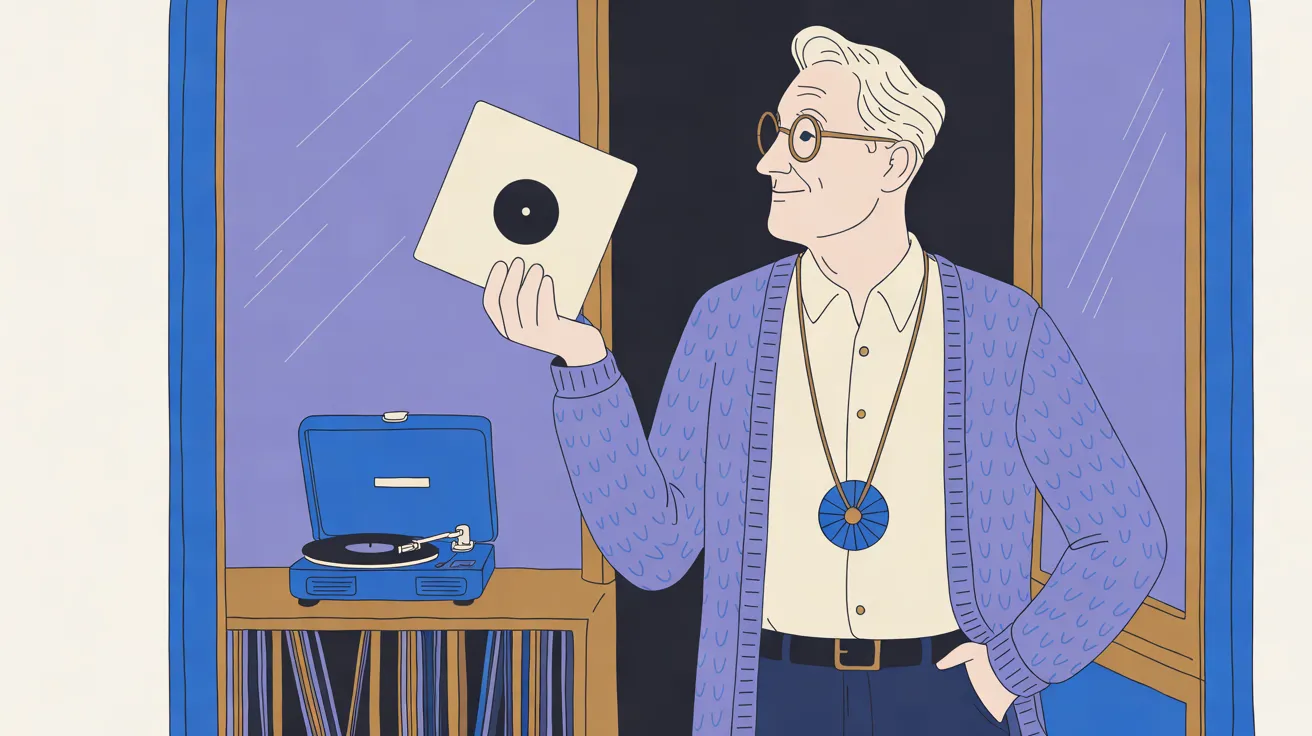
If Gelato 45 is your strain, this is your sign: the Selector. The doorway of the last shop in the old arcade, late afternoon, a single turning on the little blue player by the window, and you holding another up in its plain sleeve, already thinking of the other side.

The Selector, an older man with swept-back white hair and round glasses, in a periwinkle cardigan over an open-collared cream shirt, stands in a dark shop doorway at the right, one hand in his trouser pocket, smiling as he holds up a record in a plain cream sleeve and looks at it. A spoked cobalt-blue disc hangs from a cord around his neck. To the left a blue portable record player sits on a wooden shelf of records in front of a periwinkle window, beside a plain cream wall.
The single turns on the little blue player, light streaks the window glass, and the afternoon slides an inch toward five.

If Gelato 45 is your strain

You play the other side first. Everybody already knows the A-side; it is the song in their head, the reason they walked in. You set it on the counter, turn it over and drop the needle on the side nobody asked for. Nine times in ten they stay for the whole three minutes. The tenth time, you learn something, and you write nothing down, because you will remember.

You listen before you choose. Someone comes in and hums a song they half remember, the wrong half of it, and you nod and go to the bins without a word. You are not looking for the song they asked for. You are looking for the one they meant, and you find it more often than either of you can explain. You carry the hummed half around for days afterwards, just in case it turns up.

At your best you are the person who hands a stranger a record and changes their afternoon. The arcade drifts in toward five o’clock, a shoe mender, two students, a woman with a bag of oranges, and nobody plans to stay, and they stay. You laugh easily and at the right moments, usually half a second before the song does something good.

Your flaw is that you will not part with a record to someone you think will not love it. You talk people out of things. You hide your favorites at the back of the bin so that only the patient find them. It is not stubbornness; you simply cannot watch a good song go to the wrong home. The people who love you have learned to ask what you would play, not what you have.

What you need is a narrow shop with good light at the end of the day, one working turntable, a crate of singles nobody has sorted yet, and someone in the doorway who says, “Play me the other side.” Give you that, and the afternoon keeps turning.

Your sign at a glance

Your hour
Late afternoon, when the light comes in sideways
Your place
The last shop in the arcade
Your object
A single in a plain paper sleeve
Your tempo
Forty-five turns a minute
Your weather
Dust in a slant of gold light
Your flaw
You never play the A-side first

Your people

  • The Funky Gourmet (Blue Cheese)The Funky Gourmet buys records for his parties and always asks for the A-side. You send him home with the B-side. He calls the next morning to say you were right.
  • Cindy at Midnight (Cinderella 99)Cindy has exactly three minutes, which is exactly one single. You keep one wrapped by the door for her, and she has never once stayed for the end of it.
  • The Night Owl (Purple Urkle)The Night Owl shelves the night’s books and you shelve the afternoon’s records. You both file by feel and pretend there is a system.

Things you say

  • Everybody knows the A-side.
  • Hum me the part you don’t remember.
  • Three minutes is long enough to change an afternoon.
  • If you’re not sure, play the other side.
  • Keep the sleeve plain. You’ll remember which side.

A scene from your world

The other side

The Selector opens the shop at four, which is late for a shop and early for the arcade. By then the sun has come round far enough to reach under the glass roof, and it lies in long gold bars across the floor tiles, periwinkle and cream, all the way down to his door. He props the door with a crate of singles nobody has sorted, sets the little record player on the counter and puts on a B-side, which is how the arcade knows he is open.

The shop is the width of a wardrobe and holds one thing: singles, seven inches across, one song a side. They live in wooden bins in plain cream paper sleeves, no pictures, nothing written on the outside, filed by a system the Selector has never put down on paper. The adapters live in a jar on the counter, little spoked discs in cobalt blue, so that a single will sit on any spindle in the city.

At twenty past four a young man comes in out of breath, wanting a song. He hums it. He hums the wrong half of it, the chorus everyone knows, and asks if there is any chance. There is every chance. The Selector goes to the third bin without looking, lifts out a sleeve and slides the single onto the spindle. Then he turns it over. “That’s the wrong side,” says the young man. “That’s the other side,” the Selector agrees, and lowers the needle.

It starts with a hiss and a bass line that seems to have walked in from another building. The young man opens his mouth to object and closes it again. Out in the arcade the shoe mender stops tapping. Two students drift over from the stationer’s and lean in the doorway. A woman sets down a bag of oranges. Nobody planned to stay; it is three minutes; they stay.

When it ends there is only the soft tick of the run-out groove going round. The young man asks to hear it again. The Selector plays it again. Then, because he is not unkind, he turns the record over and plays the side the young man came in for, and the young man finds he likes it less than he did an hour ago, and more than he will tomorrow.

The Selector slides it into a fresh cream sleeve, drops a cobalt adapter in with it and writes nothing on the outside; the young man knows which side he wants now, and takes it home. By five the light has slid off the floor and up the far wall, the students are arguing about the bass line, and the Selector is already into the next crate, holding each single up to the last of the sun to read the grooves, turning it over before he has heard the front.

The arcade

The arcade
A covered passage of small shops under an arched glass roof, built for a busier century. At the end of the afternoon the sun reaches under the glass and lays gold across the floor, and the whole passage slows down to look at it.
The last shop on the left
The width of a wardrobe. Singles only, one song a side. The door is propped open with a crate of records nobody has sorted yet.
The bins
Wooden, waist-high, full of plain cream sleeves with nothing written on them. There is a system. Only one person knows it, and he is not telling.
The adapter jar
Little spoked discs in cobalt blue, so a single fits any spindle in the city. One goes into every sleeve that leaves the shop.
The other side
The side nobody asked for. In this shop it is played first, always, and it is the reason most people come back.
The run-out groove
The soft tick at the end of a record, going round and round. In the arcade it means: do you want to hear it again? The answer is usually yes.

The Selector, from every side

The Selector character sheet on a warm cream background: three identical full-body front views of an older man with gray hair, light freckles and round orange glasses, in a periwinkle cardigan over a cream shirt, dark trousers and tan shoes, a spoked periwinkle disc on a cord around his neck and a record in a cream sleeve at his side. He has the same calm closed-mouth smile in all three.
The Selector from every side: cardigan, buttoned collar, a single in a plain sleeve and the cobalt adapter on its cord, and the one face of a late afternoon: the small smile when the needle finds the groove.

An original character, created for Gelato 45 by Official Cannabis. Art direction by Official Cannabis.

Wear the B-side

Pieces from this world come on a tee, a hoodie, stickers, a mug and a print.